
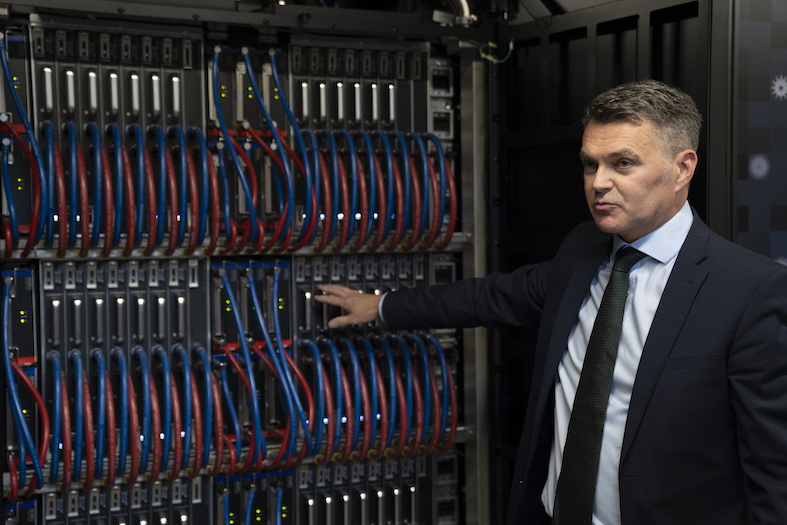
THE UK’s most powerful artificial intelligence supercomputer has been launched at the Bristol & Bath Science Park.
Isambard-AI has cost £225 million to develop and build – but can work at speeds 100,000 times faster than the average laptop, according to Bristol University, which runs the Bristol Centre for Supercomputing (BriCS).
The computer is based on what was previously part of the car park at the National Composites Centre at the park in Emersons Green.
It has been developed in close partnership with Hewlett Packard Enterprises and chip maker NVIDIA, and funded by the government as part of its AI Research Resource programme to boost Britain’s capabilities in artificial intelligence development.
Isambard-AI was officially switched on by Technology Secretary Peter Kyle at a ceremony in July.
The university says that in one second it can carry out calculations that it would take the entire population of the world 80 years to do working flat out.
Isambard-AI contains 5,400 cutting-edge NVIDIA GH200 Grace Hopper Superchips and around 100,000 times more storage than a typical 256GB phone or computer.
It has a 200Gbps data network – around 2,000 times faster than the average home broadband connection – and is ranked as the 11st fastest supercomputer in the world, and 6th fastest in Europe.
It weighs 150 tonnes but the university says it is among the greenest supercomputers in the world, as it is built to be energy efficient, using liquid cooling rather than fans.
A university spokesperson said the computer itself uses up to 4 megawatts (MW) when running flat out.
A typical kettle uses about 3kW, so Isambard-AI uses the same as about 1,300 kettles. But its consumption is far less than other supercomputers, which can use up to 30MW.
There is potential to recycle the waste heat from the computer’s cooling system to local homes and businesses. Although this is not done at present, the spokesperson said the “necessary plumbing” is in place to make this possible in the future.
Isambard-AI only uses only zero carbon electricity, the university says, and while none of this is generated on-site, solar panels could be installed in the future.
It has also been suggested that power from two proposed wind turbines next to the M4 nearby could be used directly to power the supercomputer.
BriCS director Professor Simon McIntosh-Smith said: “Isambard-AI places Bristol at the centre of the AI revolution, spearheading AI innovation and scientific discovery in important areas such as drug discovery and climate research.
“I’m incredibly proud of our team and how we’ve worked so closely with partners to develop this national facility, which will establish Bristol and the UK as an international hub for AI research.”
Mr Kyle, who recently launched a ten-year plan to boost UK’s AI computing capacity, said: “Today we put the most powerful computer system in the country into the hands of British researchers and entrepreneurs.
“Isambard-AI doesn’t just close the gap with our international competitors – it propels the UK to the forefront of AI discovery.
“The breakthroughs delivered by the AI Research Resource will define the next decade, from AI tools that spot cancer earlier, to materials that help make clean energy cheaper than fossil fuels.”